
Solar Battery Storage Designed Around Your Energy Use
A well-designed battery can store surplus solar, charge during suitable off-peak periods and reduce reliance on expensive daytime electricity. The important part is matching capacity and power to the way your home actually uses energy.
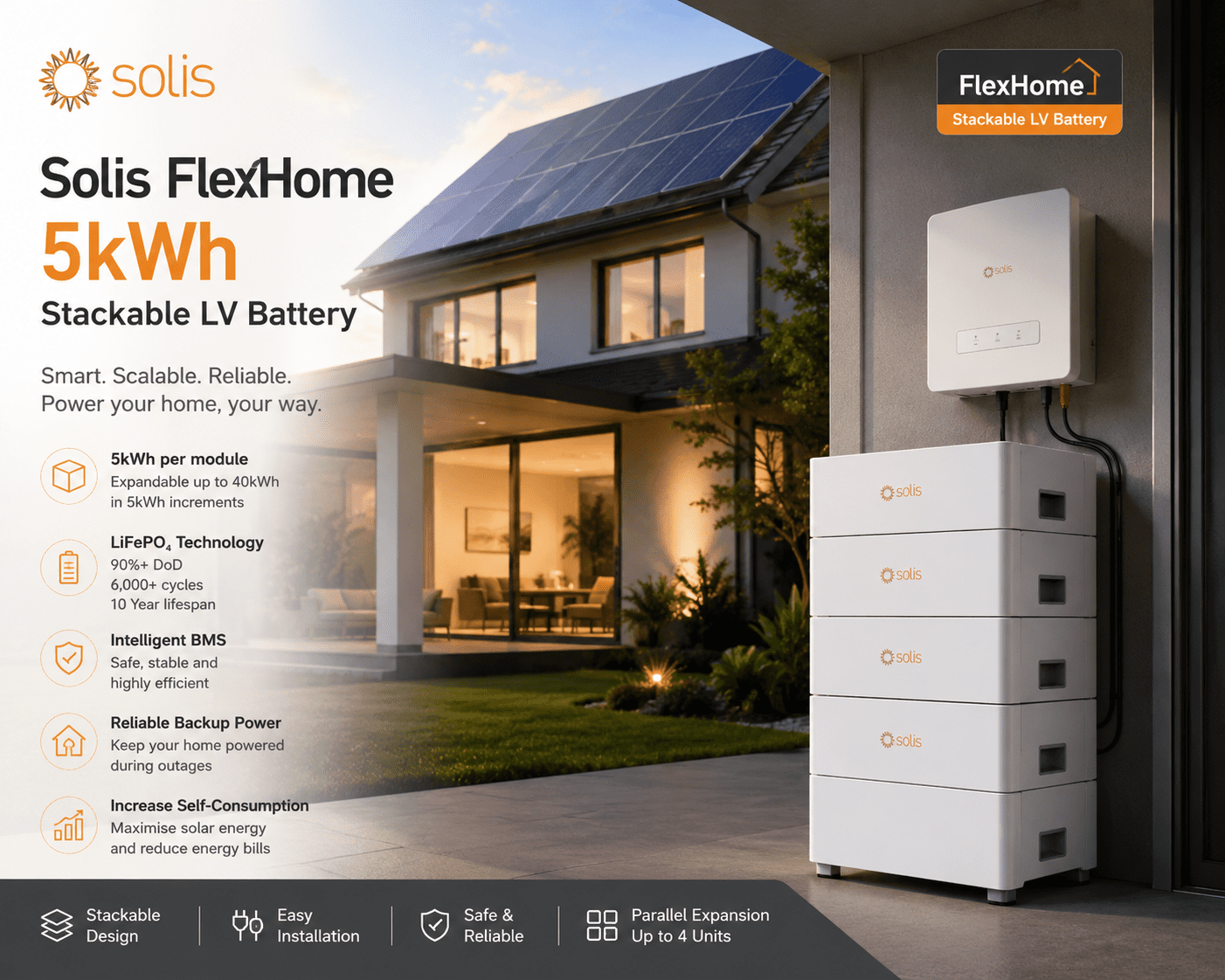
Battery size is only half the story.
A large headline capacity does not guarantee that a battery will cover high-demand appliances. Usable capacity, continuous power, peak output, inverter capability, phase arrangement and operating reserve all affect how the system performs.
Use more of your solar
Store suitable daytime surplus and use it later when household demand is higher or the array has stopped generating.
Shift grid consumption
On a suitable tariff, a battery can charge during lower-cost periods and support the home when electricity is more expensive.
Manage future loads
EV charging, heat pumps, electric cooking and home-working patterns should be considered before equipment is selected.

What will the battery actually do for your home?
- How much solar surplus is normally available?
- How much electricity is used in the evening and overnight?
- What power must the system deliver at busy times?
- Is off-peak grid charging part of the plan?
- Are backup circuits required during a power cut?
- Could the system need expansion in future?
A design based on annual usage alone can miss important peaks. We look at timing as well as total consumption.
Different routes for different starting points.
Battery with a new solar system
A hybrid design can coordinate solar generation and storage from the start, with equipment selected as one system and monitoring configured at commissioning.
- PV array, inverter and battery designed together
- Generation and battery power matched to demand
- Monitoring and tariff strategy considered early
Battery added to existing solar
An AC-coupled battery or suitable hybrid conversion may be possible. The age, warranty, meters and any FIT accreditation influence the best route.
- Review existing inverter and electrical installation
- Protect FIT metering where applicable
- Avoid replacing healthy equipment without a reason
A battery system you can understand and use.
Profile
We review consumption, solar generation, tariffs and future electrical plans.
Design
Capacity, output, inverter architecture, location and backup requirements are compared.
Install
Equipment, protection, meters and cabling are installed, tested and commissioned.
Optimise
We set up monitoring and explain charging schedules, operating modes and aftercare.
Thinking about battery storage?
Speak to Mr Solar about your solar generation, electricity use, tariff and what you want the battery to achieve.