
Wall-mounted Solis storage in several capacity classes.
The Solis IntelliHome range provides wall-mounted low-voltage battery options for compatible residential storage systems. Mr Solar assesses the 5 kWh, 10 kWh and 16 kWh class options against the property’s consumption and inverter requirements.
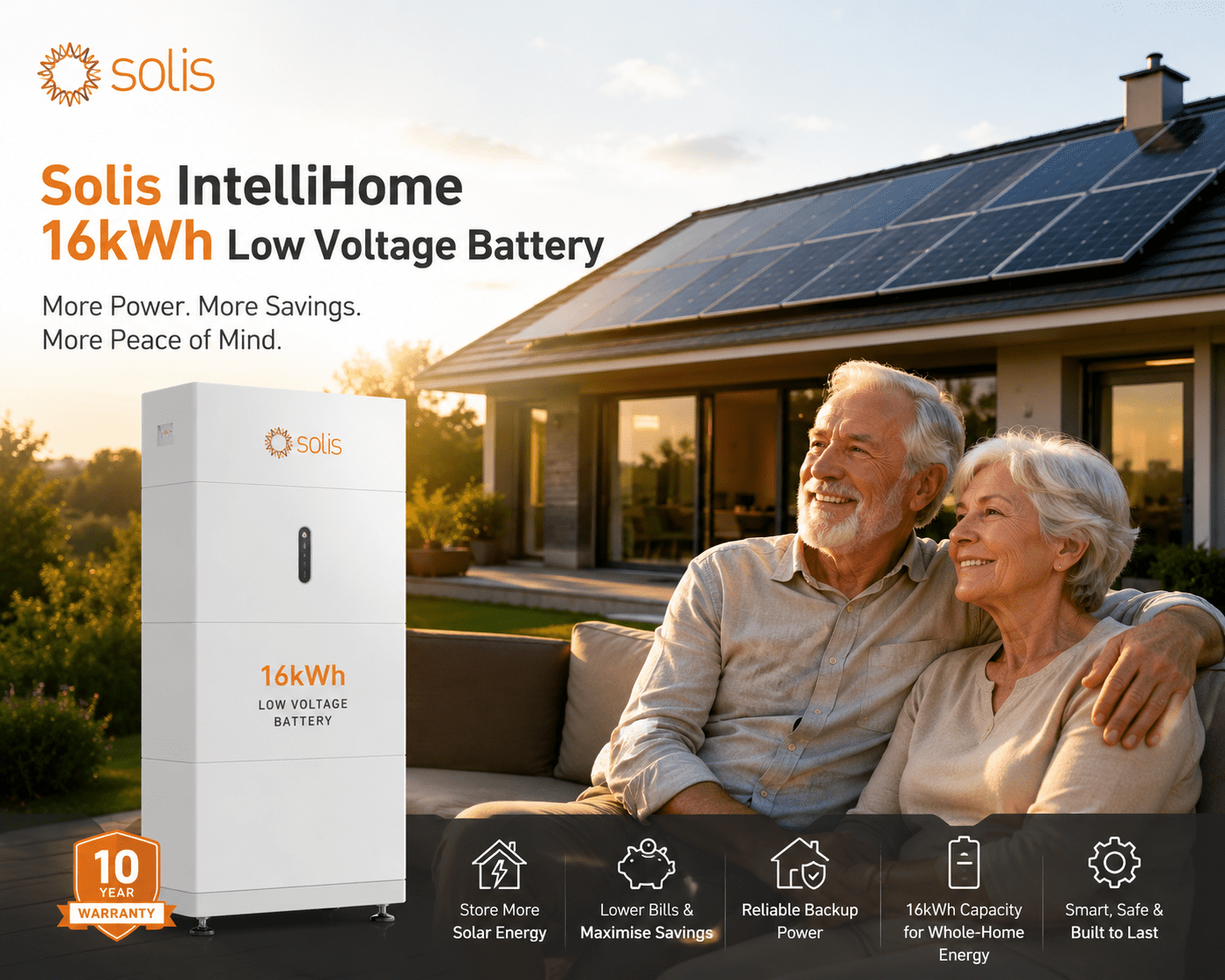
More storage is not automatically better value.
The right capacity depends on how much energy can be charged, when it will be discharged and how much power the inverter can deliver. We compare those factors before recommending a battery size.
5 kWh class
May suit lower-consumption homes, targeted tariff shifting or modest solar surplus.
10 kWh class
Can provide a broader evening and overnight energy window for suitable households.
16 kWh class
Larger storage may suit high-use homes, but only where generation, tariff strategy and discharge power justify it.
Capacity options for different household profiles.
- Solar self-consumption and evening use
- Time-of-use tariff charging where suitable
- New compatible Solis hybrid systems
- Projects where a wall-mounted form factor is preferred
Mr Solar design check
- Daily and seasonal energy profile
- Inverter charge and discharge capability
- Wall construction, access and equipment clearances
- Backup expectations versus usable energy
- Current model specifications and warranty conditions
Capacity labels do not describe the whole system. Usable energy, power, reserve settings and inverter limits all affect real performance.
Choose 5, 10 or 16 kWh around the hours you need to cover.
The capacity classes provide different energy windows, but the connected inverter still determines how much simultaneous load can be supported.
Illustrative examples
- 5 kWh: roughly 5 hours at 1 kW
- 10 kWh: roughly 10 hours at 1 kW or 5 hours at 2 kW
- 16 kWh: roughly 8 hours at 2 kW
- Electric heating, immersion heaters and EV charging can reduce those times sharply
Figures are simple energy illustrations, not guaranteed runtime. Allow for battery reserve, conversion losses, temperature, ageing and changing household demand.
Equipment selected around the complete property.
We confirm the exact model, current manufacturer documentation, inverter compatibility, electrical design, location, monitoring and any backup arrangement before equipment is ordered.
Assess
Consumption, generation, tariff, supply and future loads.
Specify
Usable energy, battery power, inverter and compatible accessories.
Install
Protection, cabling, meters and equipment installed professionally.
Support
Commissioning, monitoring setup, documentation and aftercare.
Product information should be checked against the exact model and current manufacturer documentation at quotation. Current model availability and manufacturer documentation are confirmed through Solis.
Is this battery system right for your home?
Speak to Mr Solar about your electricity use, existing solar, tariff and backup requirements before choosing equipment.