
Add storage without losing sight of the accredited solar system.
Existing Feed-in Tariff installations can often be paired with battery storage. Before work begins, check the accreditation, generation meter, inverter, export arrangement and FIT licensee notification requirements.
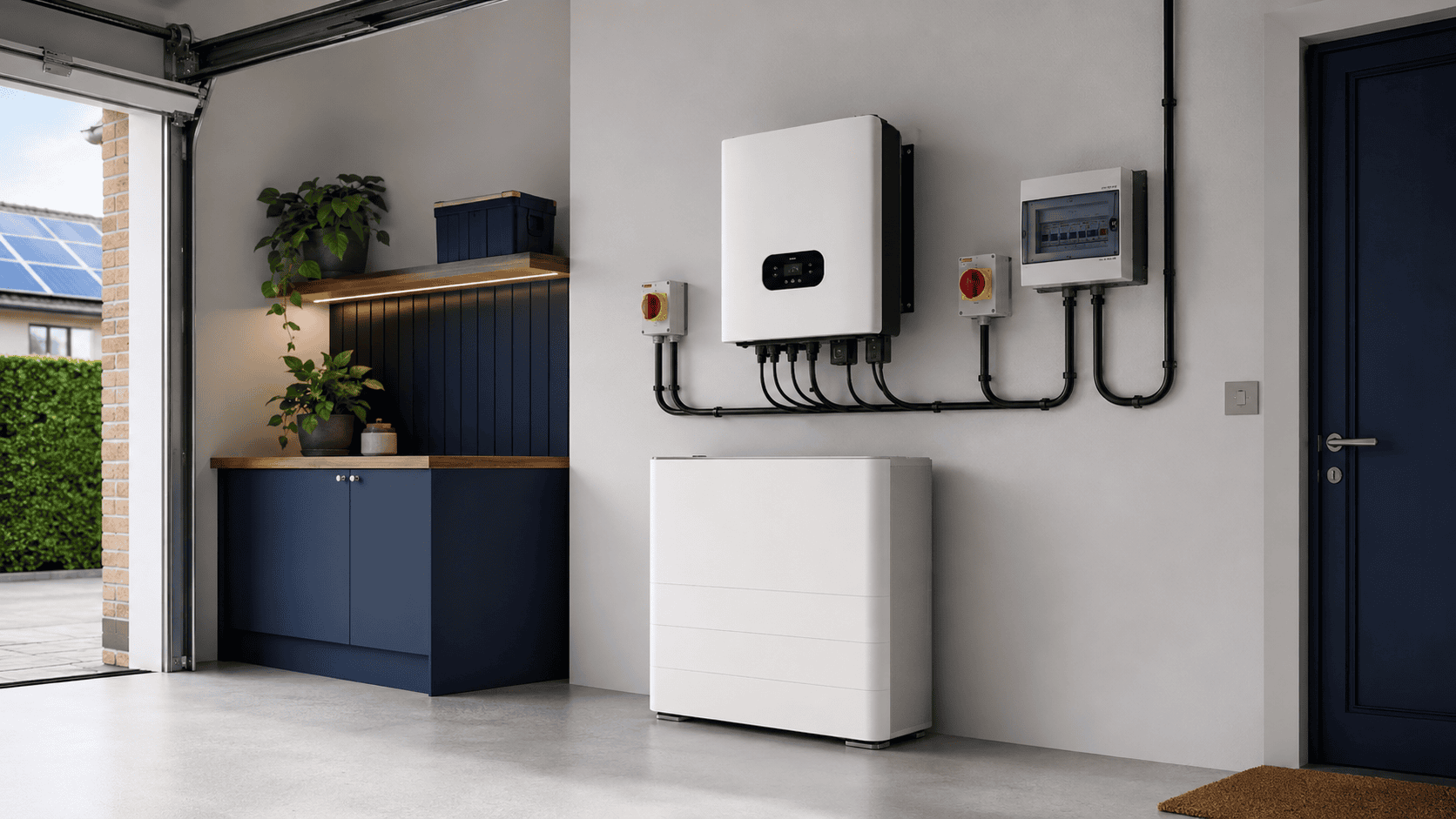
Five facts to establish before choosing a battery.
- The FIT accreditation and declared net capacity
- Current generation and export meter arrangement
- Whether export is deemed or metered
- The existing inverter make, model and condition
- What the FIT licensee requires when storage or equipment changes
This page is the quick checklist.
Our detailed guide explains AC-coupled and hybrid routes, deemed export, documentation, additional generation and the current VAT position.
Do not replace a working FIT-era inverter or move metering without understanding the consequences.
Size the battery around surplus and evening demand.
An older FIT array may generate less winter surplus than a new high-output installation. A battery should not be sized from summer production alone.
Illustrative examples
- 5 kWh may cover modest evening use where enough energy is available to charge it
- 10 kWh can provide a longer window but needs sufficient solar or off-peak grid charging
- A large battery paired with a low-power inverter may still struggle with simultaneous appliances
- If export is metered, storing more solar can reduce measured export
Figures are simple energy illustrations, not guaranteed runtime. Allow for battery reserve, conversion losses, temperature, ageing and changing household demand.
AC-coupled or carefully planned hybrid conversion.
AC-coupled battery
A separate battery inverter works alongside the existing solar inverter. This can leave the original generation system and meter arrangement substantially intact where appropriate.
Hybrid conversion
The solar inverter may be replaced with a compatible hybrid inverter. Equipment replacement, metering and FIT licensee requirements need to be reviewed and documented.
Official reference: Ofgem guidance for FIT generators.
Do you have a FIT solar system and want battery storage?
Send the FIT documents, inverter details, meter photographs and electricity-use information for an informed review.